

Your marketing budget is being spent. The product is solid. The enquiries come in. And yet something is leaking. The close rate underperforms. Clients arrive with slightly different expectations than you intended to set. The business feels harder to grow than it should be for the quality of work being delivered. This is not a marketing problem. In most cases, it is a brand problem, and specifically it is the impact of brand inconsistency on conversion rates that is doing the damage. Quietly, systematically, and largely invisibly.
The branding consistency conversation tends to get reduced to aesthetics: does the logo look the same everywhere, are the brand colours applied correctly, does the tone feel consistent? These are real concerns, but they sit at the surface of a much deeper issue. Consistent branding is a conversion mechanism. It is how trust accumulates between a business and a prospect over multiple encounters, and how that accumulated trust eventually tips a decision. Understanding the impact of brand consistency on conversion rates means understanding how the brain builds preference, and why inconsistency disrupts that process at a neurological level.
There is a second layer worth naming at the outset. Consistency alone is not sufficient if the underlying design is working against the user. A brand that is consistently confusing, consistently hard to navigate, or consistently built around aesthetics rather than how the brain actually processes information will produce consistent results: consistently poor conversion. The strategy has to address both the coherence of the brand and the cognitive quality of its design. This piece covers both.
Why Inconsistency Costs More Than You Think

Most business owners recognise inconsistency when it is pointed out to them. The website was built three years ago and reflects a positioning that has since shifted. The social media voice is warmer and more casual than the proposals. The email templates have never been updated to match the rebrand. These feel like administrative oversights. The impact of brand inconsistency on conversion rates they produce is rarely attributed correctly, because the damage does not appear in a single failed interaction. It accumulates across dozens of them.
The mechanism is rooted in cognitive psychology. When a prospect encounters a brand for the first time, their brain begins building a mental model of the business: what it stands for, what standard of work it delivers, and whether it can be trusted with a meaningful project. Every subsequent encounter either reinforces that model or introduces a contradiction. Contradictions are not processed neutrally. The brain experiences them as uncertainty, and uncertainty produces exactly one consistent commercial outcome: inaction.
Consider a financial planning firm. A prospective client sees a LinkedIn post that is polished and authoritative. They follow the link to the website, which carries a completely different visual identity and a noticeably different tone. They request a brochure that uses yet another colour palette. By the time they reach the booking page, the accumulated cognitive dissonance has produced a question the brain cannot resolve: which version of this business am I actually hiring? That question, left unanswered, produces a closed tab and a lost lead.
Inconsistency does not just look unprofessional. It activates doubt. And doubt is the single most reliable predictor of a prospect deciding not to proceed.
The Four Dimensions Where Consistency Must Hold
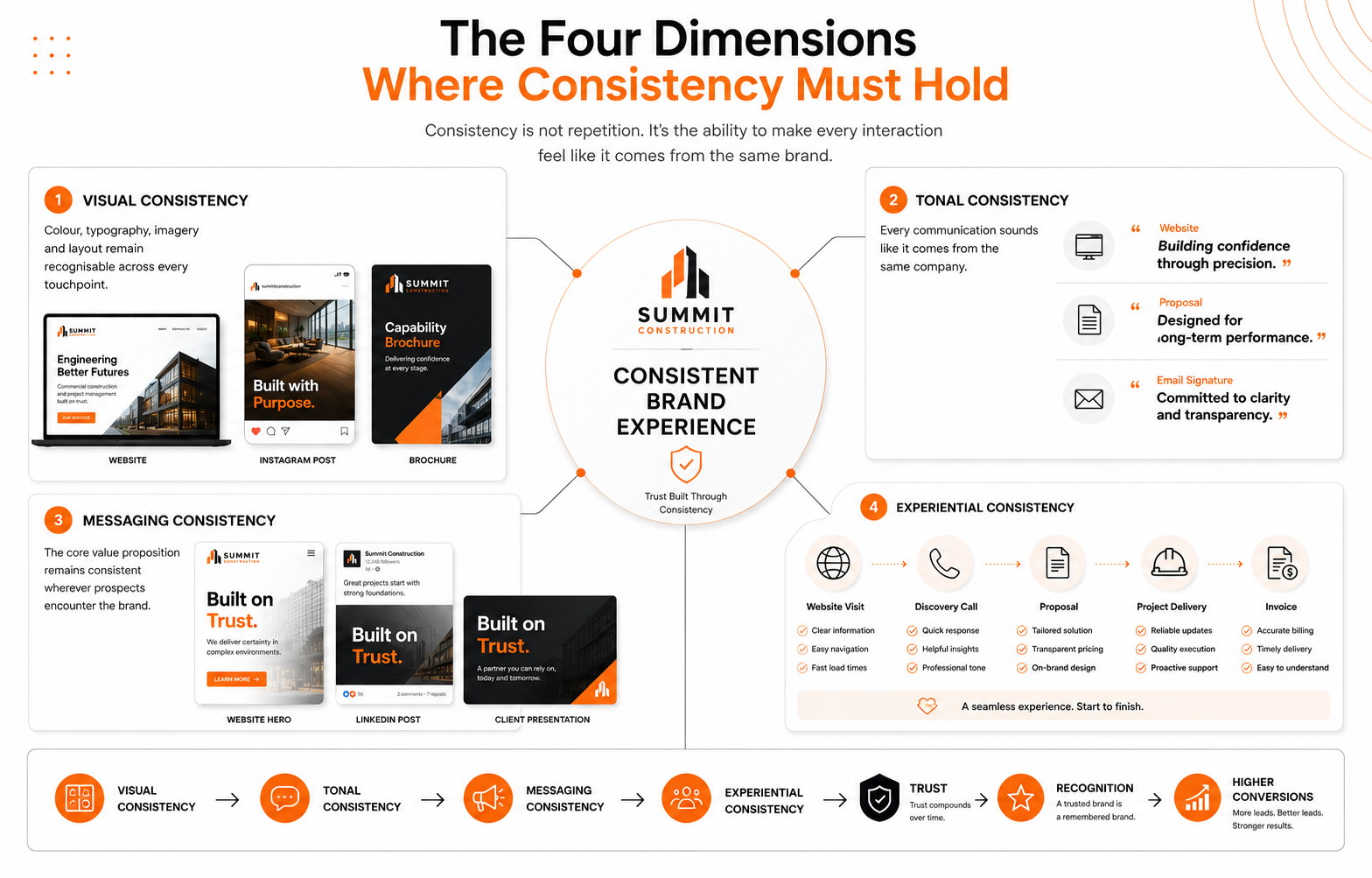
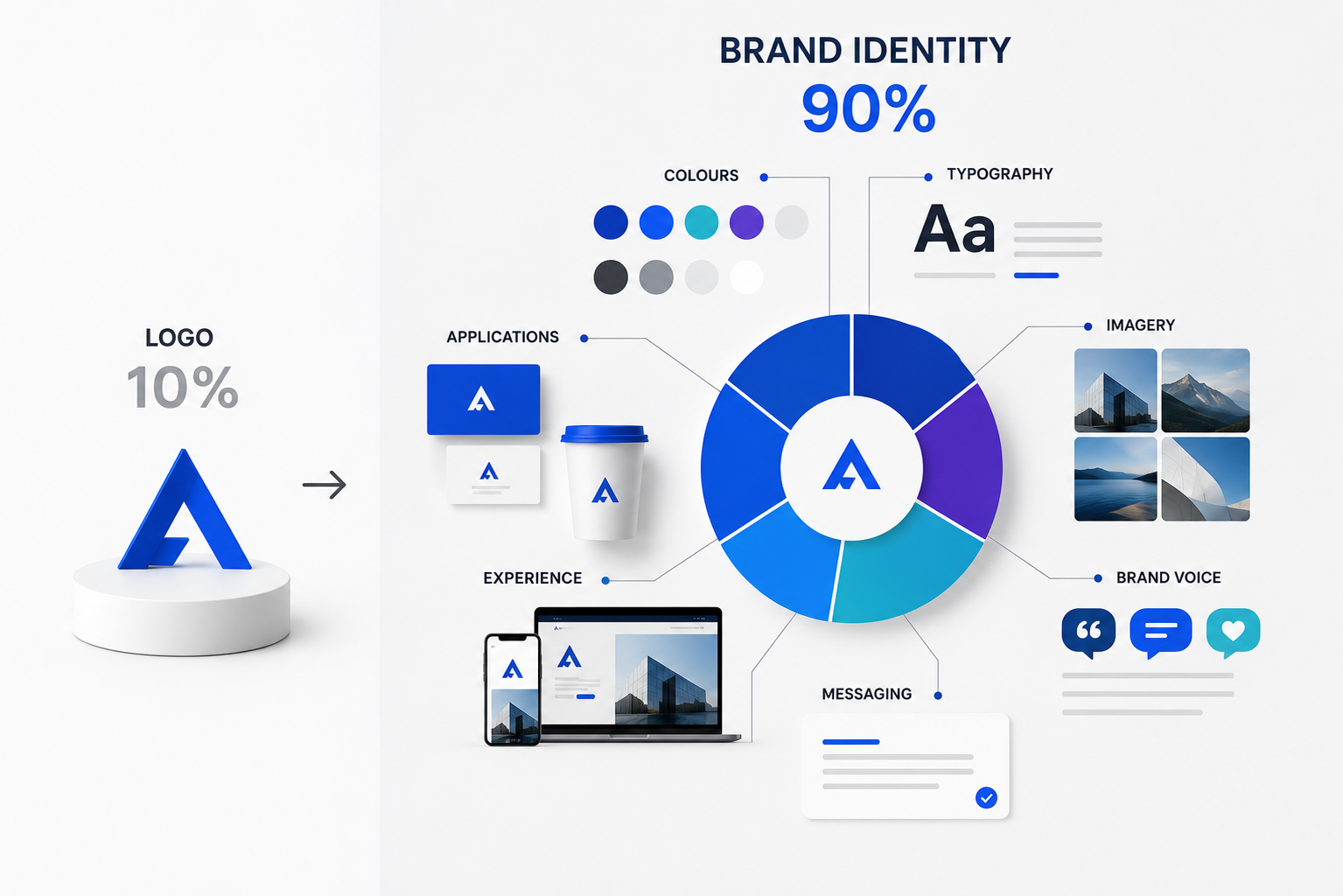
Separating consistent branding from rigid uniformity is important before going further. Consistency does not mean every piece of communication is identical. It means every piece of communication feels as though it originates from the same values, the same voice, and the same understanding of who the client is. There are four dimensions where this must hold if it is to have any measurable effect on conversion.
The first is visual consistency: the deliberate and controlled application of colour, typography, imagery style, and layout across every platform and material. The second is tonal consistency: the register and character of language the business uses, whether authoritative, warm, technical, or direct, applied without variation from website copy to email signatures to client proposals. The third is messaging consistency: the core claims the business makes about what it does and why it matters, delivered in the same language across every channel. The fourth is experiential consistency: the quality and character of every interaction a prospect or client has, from the first website visit to the final invoice.
When all four hold, the importance of branding becomes not a philosophical argument but a measurable one. Revenue per lead increases. Sales cycles shorten. The quality of inbound enquiries improves. When any one of the four breaks down, the others carry less weight than they should, because trust is only as strong as the weakest encounter that shaped it.
The Neuroscience of Familiarity and Trust
The relationship between familiarity and trust is one of the most reliably documented phenomena in consumer psychology. Robert Zajonc’s research on the mere exposure effect established that people develop a measurable preference for stimuli they have previously encountered, even when they have no conscious memory of the prior encounter. Applied to branding, this means that every consistent touchpoint a prospect experiences is building a cumulative preference for the business, whether or not the prospect is aware it is happening.
This is why branding consistency functions as a long-term conversion asset. Each encounter deposits something into a reservoir of familiarity. By the time a prospect is at a decision point, that reservoir either works in the business’s favour or it does not exist. There is no neutral state. Every interaction has either added to it or withdrawn from it.
A second mechanism compounds this effect. The human brain is a pattern recognition system. When it encounters the same visual and verbal signals repeatedly, it begins to process them with less cognitive effort. That reduction in effort is experienced consciously as comfort and confidence. An accounting firm whose brand is coherent and consistent across every surface will be perceived as more competent and more trustworthy than a direct competitor whose work is of equal quality but whose brand signals are scattered and contradictory. The prospect is not making this evaluation consciously. Their brain is making it for them, and they will act on its conclusion without being able to explain why.
Every brand touchpoint is either building trust or eroding it. There is no neutral interaction.
Where Inconsistency Hides and How It Hurts Conversion
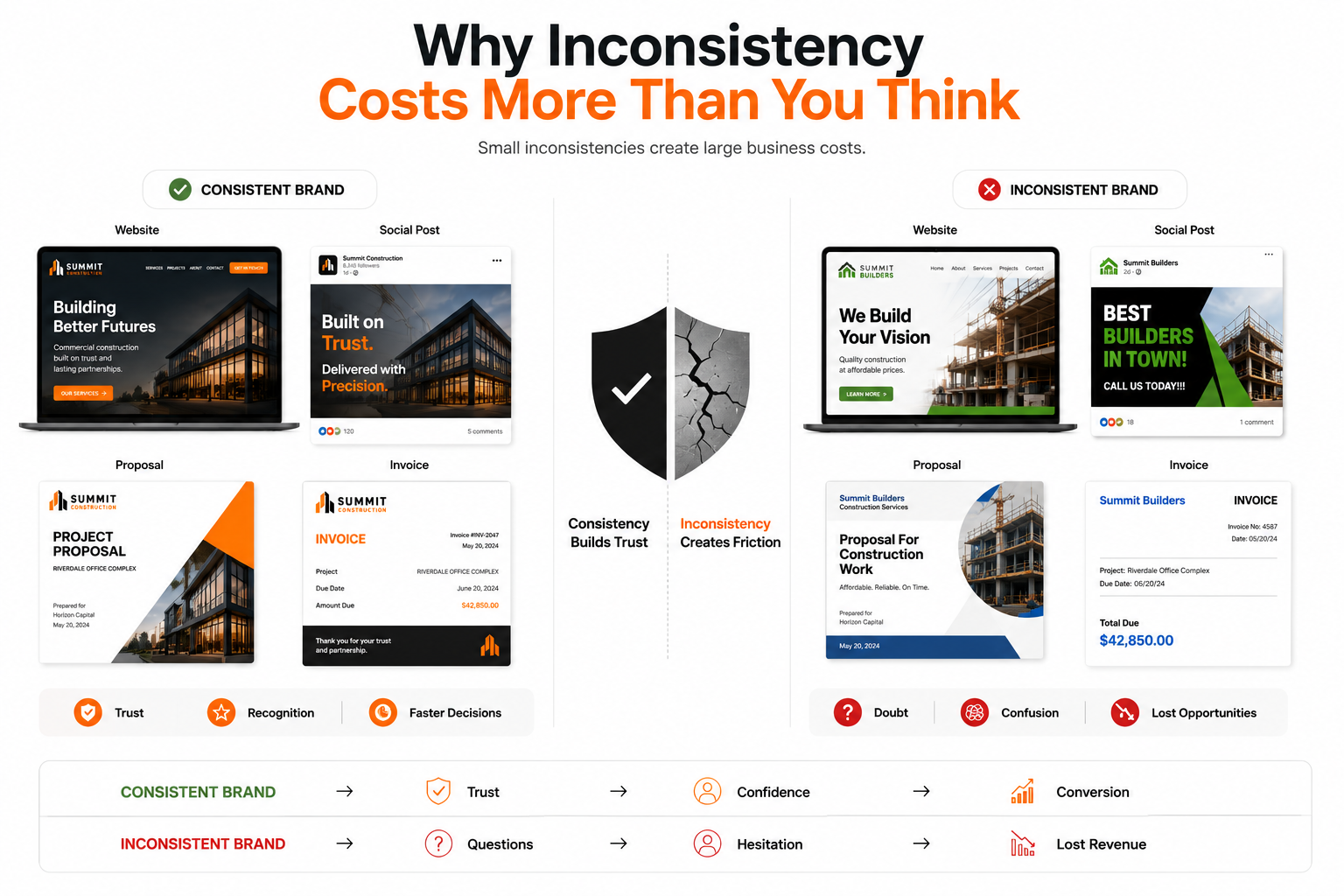
Understanding how brand inconsistency affects conversion rates and trust in practice requires looking beyond the surfaces that receive the most editorial attention. The homepage is reviewed. The brand guidelines document is produced. The social media presence is managed. But inconsistency accumulates in the places that are looked at less frequently, and those places are often where the prospect is making their final decision.
Email communication is one of the most common offenders. A business can invest substantially in its website and social presence while its email templates carry a different visual identity and a noticeably different tone. For a prospective client moving from website to inbox, the shift creates a discontinuity that is subtle but real. The business that felt premium at the website level feels less considered in direct correspondence.
Proposals and pitch documents are another critical gap. A healthcare consultancy that presents a polished brand online but sends proposals in a default Word template is communicating something about its standards that its website worked hard to contradict. The proposal is a brand touchpoint. So is the invoice. So is the onboarding document. So is the automated confirmation email. Each one either reinforces the brand impression or introduces a crack in it.
These are the brand mistakes that do not appear in a brand audit because they were never included in the scope. The businesses that successfully improve conversion rate over time are those that have conducted an honest audit of every surface where a prospect encounters them, not just the ones that feel like marketing.
Brand Messaging Is Where Conversion Is Won or Lost
Visual consistency is the most immediately visible dimension of a coherent brand, but it is brand messaging that carries the greatest weight in converting prospects into clients. Messaging is the verbal architecture of the brand: the claims made, the language used to make them, and the consistency with which that language appears regardless of channel or format.
When messaging is inconsistent, the conversion problem is specific and predictable. A prospect who visits a website that positions the business around speed and responsiveness, then reads a LinkedIn article that emphasises deep strategic thinking, and then receives a proposal that leads with competitive pricing, is being asked to hold three different value propositions simultaneously. They cannot reconcile them. The brain resolves the ambiguity through the path of least resistance: this business does not know what it is, which means I do not know what I am buying.
The importance of consistent branding in messaging terms is the creation of a single, repeatable answer to the question every prospect is already asking: why this business over every other option? When that answer is delivered in the same language, through the same lens, across every touchpoint, it compounds. The prospect does not arrive at a decision through a single persuasive moment. They arrive at it through the accumulated weight of a message that has never contradicted itself.
What Consistency Does to Your Website Conversion Specifically
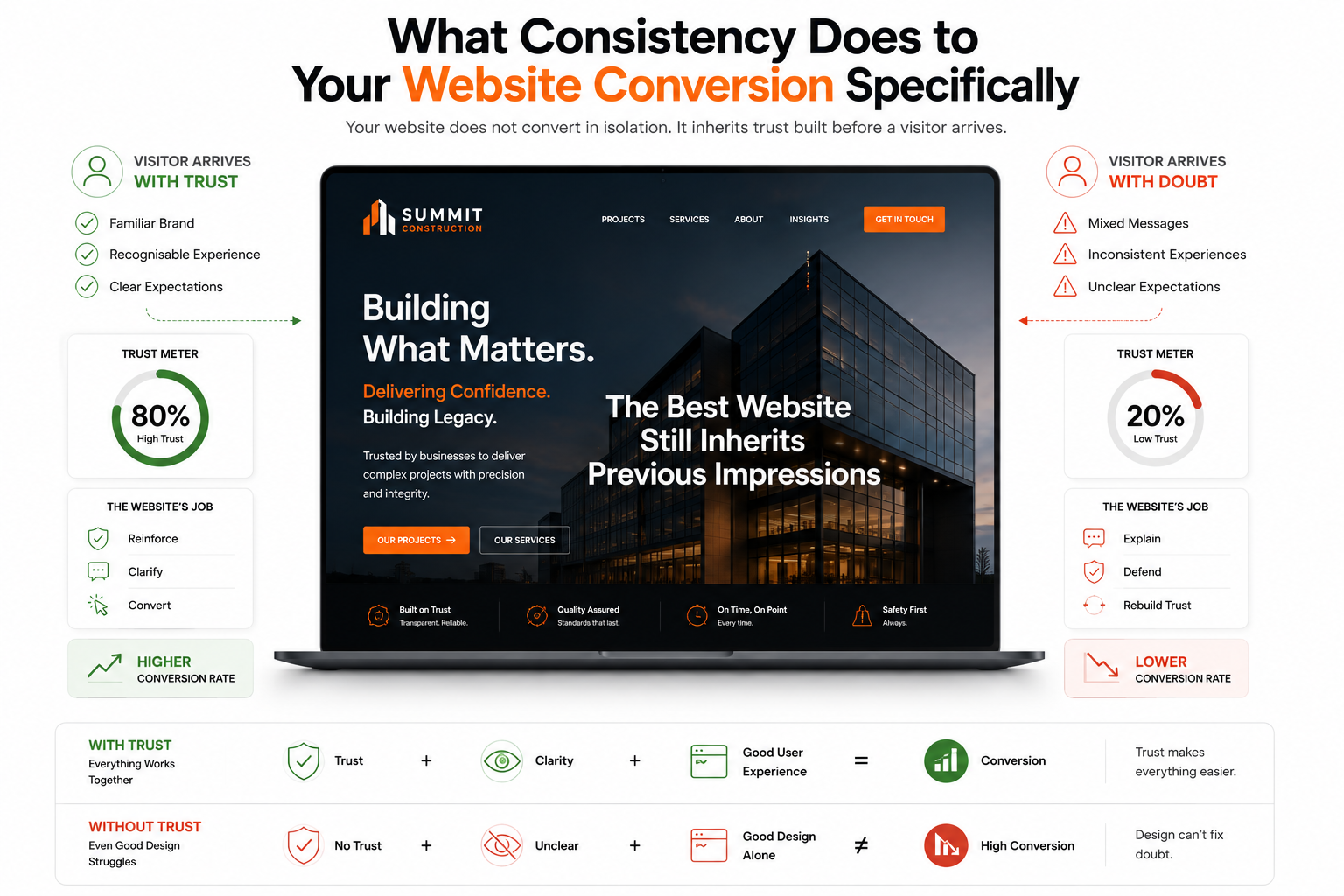
The website is where most businesses concentrate their conversion optimisation effort. But the website does not convert in isolation. A prospect who arrives at a website having already encountered a coherent, consistent brand across other channels brings a pre-established level of trust with them. Their brain has already begun to process the business as familiar and credible. The website’s job in that scenario is to deepen an existing impression and guide a decision, not to build trust from zero.
For a business with strong branding consistency, the website converts more efficiently because it is not carrying the full weight of the relationship. The prior touchpoints have done work. The homepage inherits that work rather than having to undo the damage of inconsistency before it can begin persuading.
The inverse is equally true and considerably more common. A business with inconsistent branding that invests in a website redesign will typically see results that fall short of projections. The website improves. The conversion rate does not improve proportionally. The reason is that the website was never the problem. The prospects arriving at it were already carrying doubt accumulated from earlier encounters. A redesigned homepage cannot resolve doubt that was created in an email template six weeks earlier.
A website redesign cannot solve a brand consistency problem. It can only make the inconsistency more visible by contrast.
Design Quality and Consistency Are Not the Same Investment
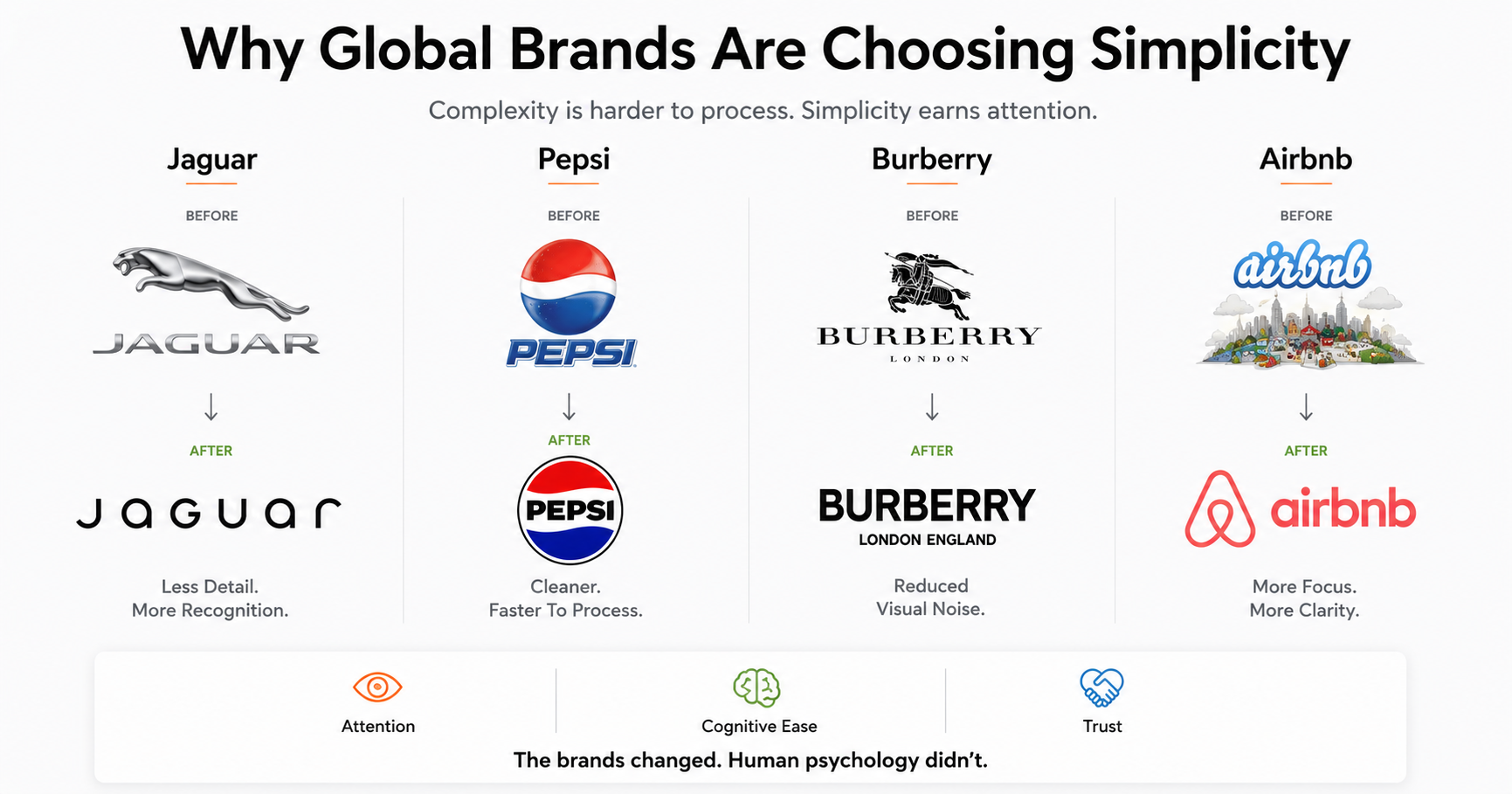
One of the less discussed dimensions of branding consistency is the quality of the design itself, separate from whether it is applied uniformly. A brand can be perfectly consistent and still underperform commercially if the underlying design is working against the user’s cognitive process rather than with it.
Design that prioritises aesthetics over function, that requires the user to expend effort to find information, or that presents visual complexity where simplicity would serve better, produces cognitive load. And cognitive load suppresses conversion regardless of how consistently the brand is applied. A confusing experience delivered uniformly across every touchpoint is still a confusing experience.
The businesses with the strongest commercial outcomes from their brand investment are those that have addressed both dimensions: the coherence of the brand across all surfaces and the cognitive quality of the design itself. Neuro Design, the application of behavioural science and cognitive psychology to visual and experience design, is the framework through which both are addressed simultaneously. It ensures that the brand is not only consistent but that its consistency is built on a design logic that reduces friction, builds confidence, and guides the user toward a decision with minimal effort.
The Conversion Audit: Where to Start
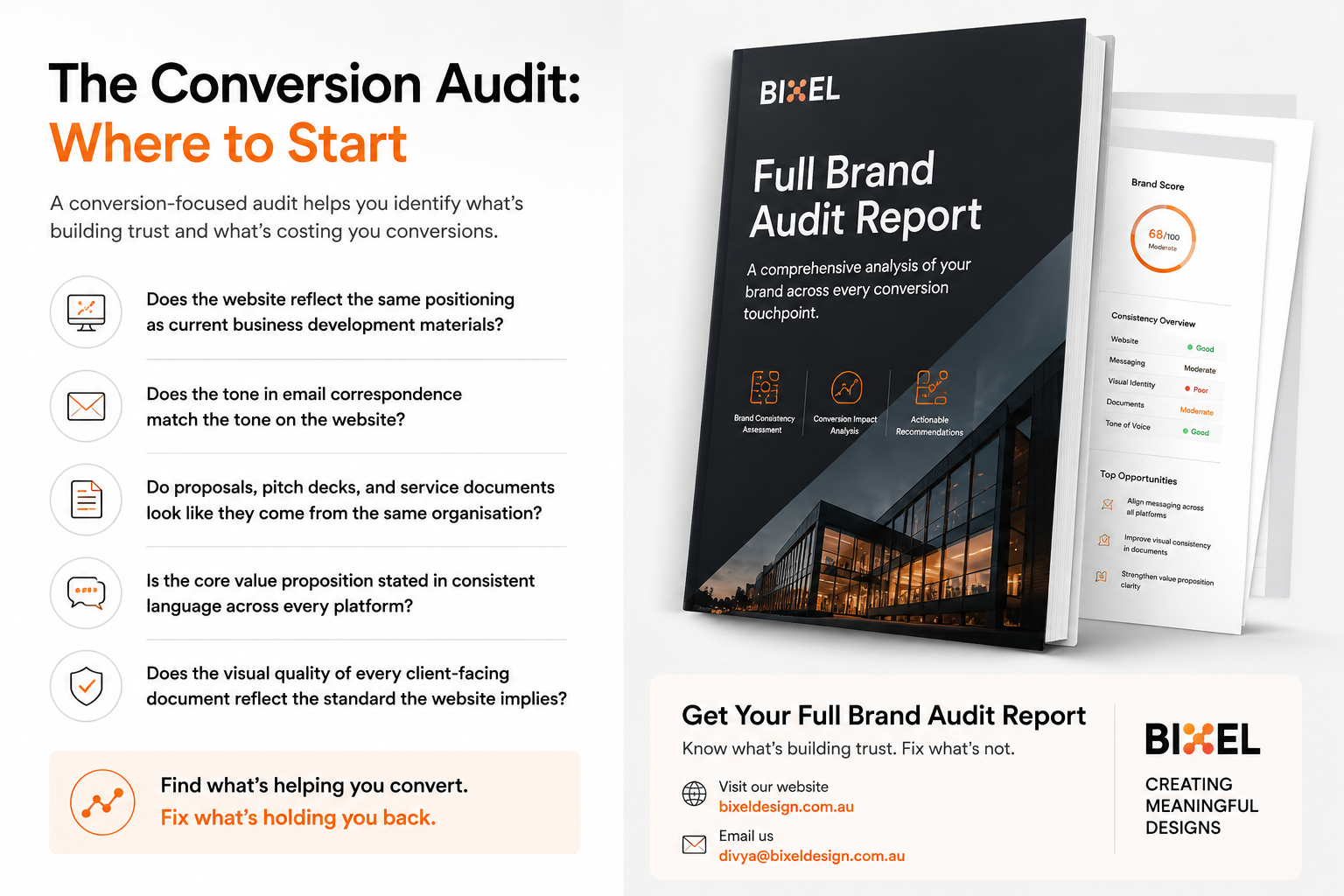
For most businesses, the first practical step toward genuine branding consistency is a conversion-focused audit of existing touchpoints. Not a creative review. Not a design refresh. A structured assessment of every surface where a prospect or client encounters the business, evaluated against a single question: does this reinforce or undermine the impression the business is trying to create?
- Does the website reflect the same positioning as current business development materials?
- Does the tone in email correspondence match the tone on the website?
- Do proposals, pitch decks, and service documents look like they come from the same organisation?
- Is the core value proposition stated in consistent language across every platform?
- Does the visual quality of every client-facing document reflect the standard the website implies?
Where the answer to any of these is uncertain or negative, a conversion leak has been identified. Not a branding problem in the abstract, but a specific, addressable gap between the experience currently being delivered and the experience required to build the trust that converts. These gaps are the brand mistakes that are easiest to overlook and most costly to ignore.
The Long View on Consistency
Businesses that take branding consistency seriously understand something their competitors tend not to: trust is not the outcome of a single impressive interaction. It is the outcome of many consistent ones. Each encounter either compounds the impression the business is trying to build or introduces friction that the next encounter must overcome.
The businesses with the strongest conversion rates, the shortest sales cycles, and the most loyal client relationships are rarely those with the largest budgets or the most aggressive marketing. They are the ones whose brand is so coherent, so consistently expressed, and so clearly grounded in an understanding of how their prospect thinks and decides, that by the time a decision point arrives, the choice feels obvious rather than considered.
That kind of brand does not emerge from a single project. It is the result of a deliberate strategy applied with discipline across every surface of the business. If you are ready to build it, we would be glad to consult with our team today and map out what a consistency-led, conversion-focused brand approach could look like for your business.
Here are some of our case studies you may find useful before reaching out to us.
Contact Bixel Design
Website: https://bixeldesign.com.au/contact/
Email: divya@bixeldesign.com.au