

You have launched the website. You have done the keyword research. You are publishing content and building links. Six months in, the traffic barely moves. The rankings that were supposed to come have not arrived. The leads are not coming through. This is one of the most common and most demoralising experiences in digital marketing, and the frustrating truth is that it rarely has anything to do with your SEO execution.
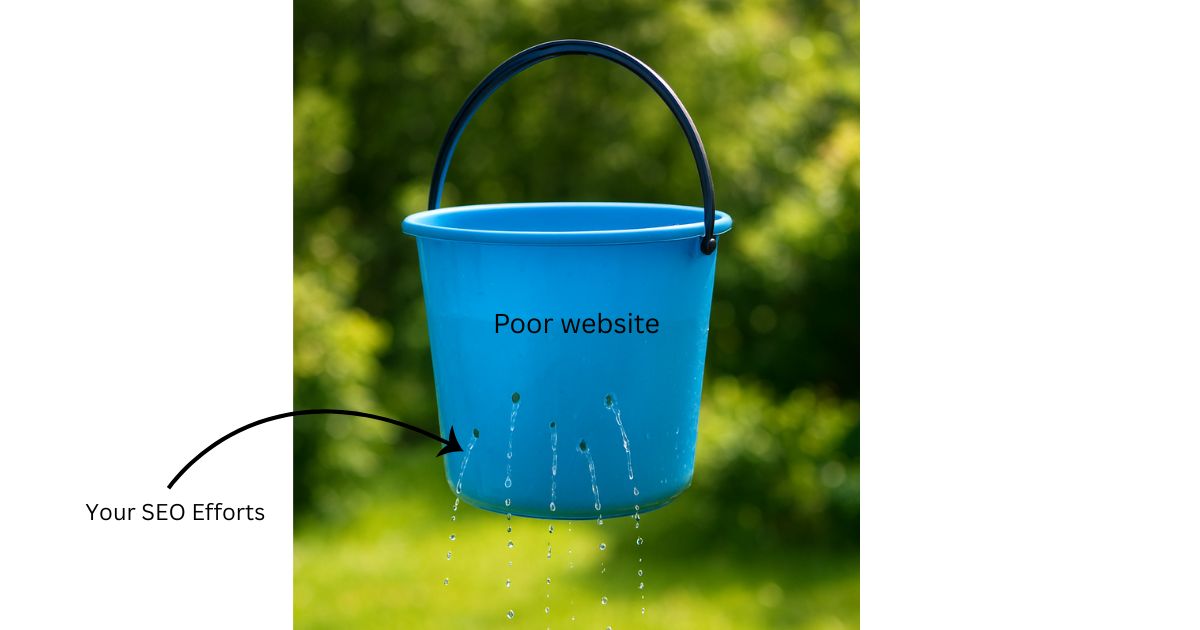
The reason most SEO strategies fail is not tactical. It is foundational. Google’s entire business model is built on surfacing the most relevant, trustworthy, and high-quality result for every search query. If the website underpinning your strategy does not meet those standards, no volume of backlinks, meta descriptions, or keyword-optimised content will compensate. You are pouring water into a bucket full of holes.
Understanding why SEO fails for most businesses means looking at the website itself before looking at the strategy sitting on top of it. This piece works through the foundational issues we see most consistently when auditing sites that have plateaued or never gained traction, and what to do about each of them.
The Leaky Bucket Problem
A useful way to think about the relationship between your website and your SEO is the leaky bucket analogy. SEO is the water. Your website is the bucket. If the bucket has structural problems, it does not matter how much water you pour in. It will always leak.
In practical terms, this means that a website with poor architecture, slow load times, weak mobile performance, or confusing structure will receive visitors through organic search and then lose them almost immediately. Google measures this through behavioural signals: time on site, bounce rate, pages visited per session, and whether the user returns to the search results after visiting your page. When those signals are consistently poor, the algorithm interprets them as evidence that your site did not answer the query well, and your rankings decline accordingly.
This is one of the most underappreciated SEO challenges for service businesses. The content may be genuinely strong. The keywords may be well researched. But if the experience the website delivers is poor, the behavioural data sent back to Google undermines every other signal you are trying to build. The foundation has to be addressed first.
“SEO earns you visibility. Your website earns you trust. Without both working together, you either have no visitors or no customers.“
Website Architecture: What Google Actually Crawls
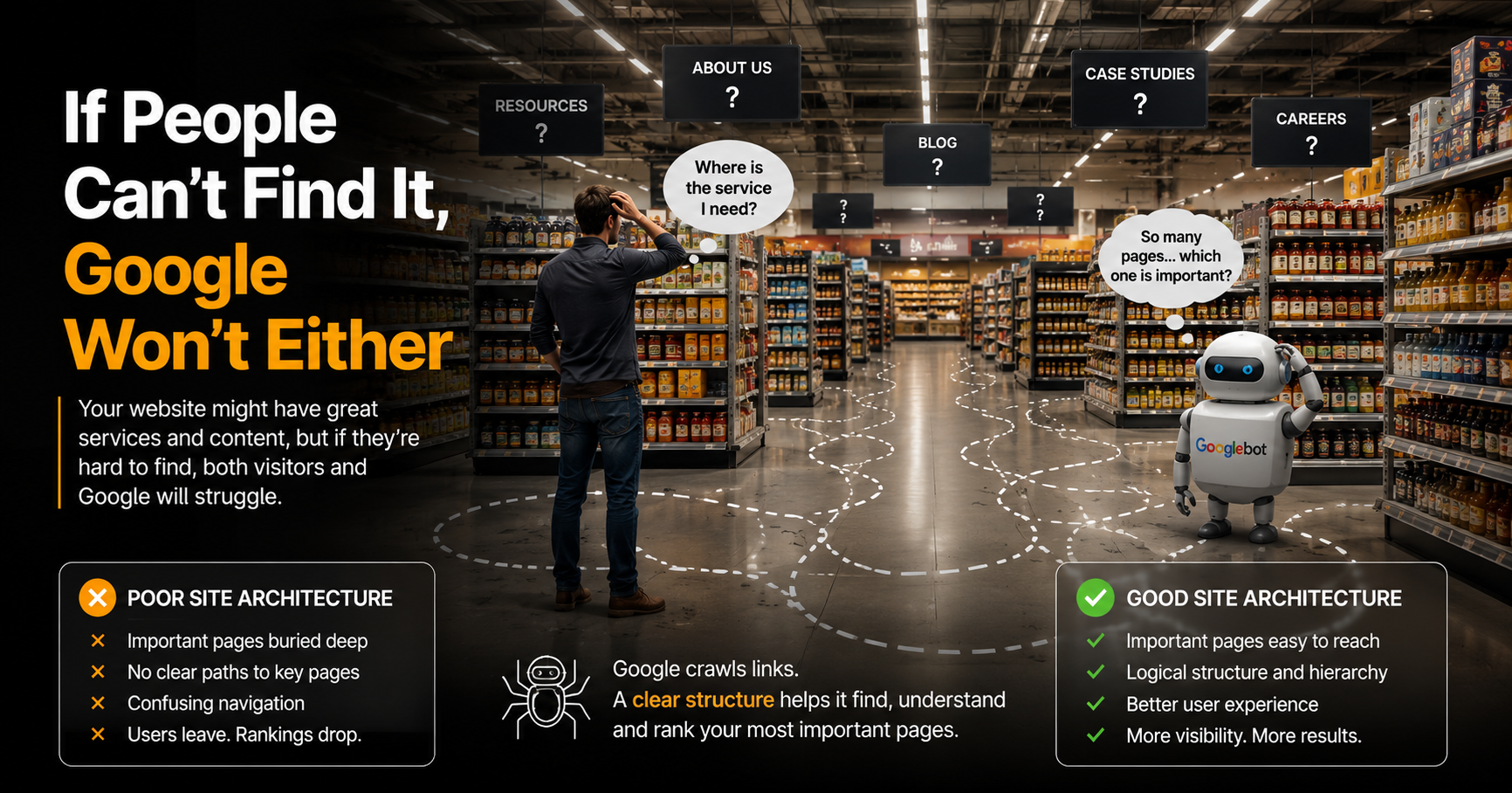
Your site architecture is the structural logic of how your pages relate to and link to one another. It is the map both human visitors and Google’s crawlers use to understand what your website is about and what it contains. Poor architecture is one of the most common SEO problems we encounter in audits, and one of the most consequential.
A flat architecture, where any page on your site is reachable within two to three clicks from the homepage, is the standard to aim for. This structure signals to search engines that your content is organised, intentional, and accessible. Deep or illogical structures, where important service pages are buried several levels down or orphaned with no internal links pointing to them, mean that Google either does not find those pages efficiently or assigns them lower priority when it does.
Beyond crawlability, architecture shapes user experience. A prospective client who cannot find your services page within two clicks of landing on your homepage is a prospective client who leaves. That exit is a behavioural signal that compounds your SEO issues over time. The structure of your site is not a technical detail. It is a direct input into your rankings.
Speed Is Not a Nice-to-Have
Page speed is one of the most clearly documented factors in both SEO performance and conversion rate. Google has confirmed page experience, which includes loading speed, as a direct ranking signal. The data behind this is unambiguous: according to Google’s own research, the probability of a user bouncing increases by 32 percent as page load time increases from one second to three seconds. At five seconds, that probability rises to 90 percent.
For context, the average webpage takes between three and five seconds to fully load on mobile. Which means the average webpage is operating in the zone where more than half of its visitors are statistically likely to leave before the page is ready. This is not an edge case. It is one of the most widespread and most fixable SEO challenges facing small and mid-size businesses, and it is almost always a result of unoptimised images, render-blocking scripts, or inadequate hosting rather than anything inherently complex.
Google PageSpeed Insights and Core Web Vitals reports will surface specific issues on your site. The three metrics to focus on are Largest Contentful Paint (how long the main content takes to load), Cumulative Layout Shift (how much the layout moves around during loading), and Interaction to Next Paint (how quickly the page responds to user input). Improving these three scores has a direct and measurable impact on both rankings and on-page conversion.
Mobile Performance Is Now the Primary Standard
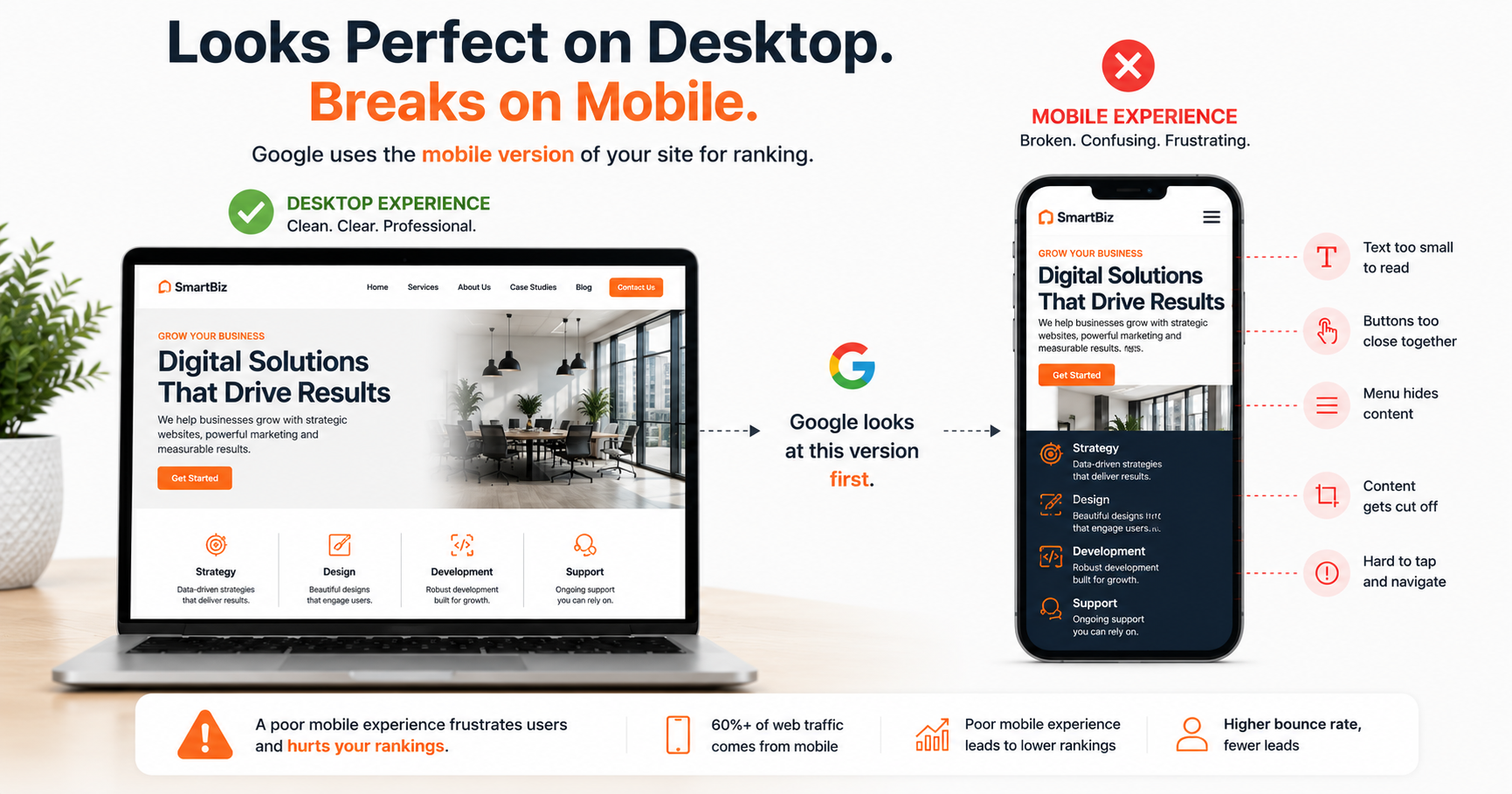
Since 2019, Google has operated on a mobile-first indexing model. This means the mobile version of your website is the version Google primarily uses to determine your rankings, regardless of how polished your desktop version looks. With mobile devices now accounting for more than 60 percent of global web traffic, this is not a concession to a minority use case. It is the dominant one.
The most common reasons SEO fails on mobile-first indexed sites include text that is too small to read without zooming, buttons or links placed too close together for reliable tapping, navigation menus that collapse poorly on smaller screens, and content that is hidden or truncated on mobile but visible on desktop. Each of these creates friction that users will not tolerate when alternatives are one tap away.
Testing your site across multiple device sizes is not a one-time exercise. As your content grows and your design evolves, mobile performance needs to be verified consistently. A page that works perfectly on desktop and breaks on a four-year-old Android phone is, from Google’s perspective, a page that does not work.
Clarity and Cognitive Load: Why Less Content Performs Better
One of the less intuitive SEO problems is overcrowded content. The instinct to cover everything thoroughly is understandable. The result is often pages that overwhelm users before they have found what they came for.
Research by the Nielsen Norman Group found that users read, on average, approximately 28 percent of the text on a webpage. The rest is scanned or skipped entirely. This does not mean content quality is irrelevant. It means that how content is structured determines whether its quality is ever encountered. Long unbroken paragraphs, pages dense with information across multiple topics, and layouts with no clear visual hierarchy all increase cognitive load, the mental effort required to extract meaning from a page.
From an SEO perspective, high cognitive load correlates directly with high bounce rates, and high bounce rates correlate with ranking suppression. The goal is not to say less. It is to structure what you say in a way that reduces the effort required to read it. Short paragraphs, clear subheadings, deliberate spacing, and a single focused argument per section are the structural tools that keep users reading, and keep Google interpreting your site favourably.
Google does not rank content. It ranks the experience of reading content. Structure and readability are SEO variables, not just design ones.
Trust Signals and Why Google Cares About Them
One of the dimensions of why SEO is so difficult for service businesses specifically is that Google’s quality evaluation framework, summarised as Experience, Expertise, Authoritativeness, and Trustworthiness (E-E-A-T), requires the website itself to demonstrate credibility, not just claim it.
Client testimonials, named case studies, verifiable credentials, Google reviews, and portfolio work are not just sales tools. They are trust signals that Google’s quality evaluators look for when assessing whether a website deserves to rank for competitive terms. A professional services website with no social proof, no demonstrable client history, and no evidence of real work is a site that will consistently underperform in organic search regardless of how well its technical SEO has been executed.
This is particularly relevant for businesses in legal, financial, healthcare, and consulting sectors, where Google applies its highest scrutiny under the Your Money or Your Life classification. In these categories, the barrier to ranking is not just technical competence. It is demonstrated credibility. Building that into the site architecture, not just the content, is one of the most important and most overlooked elements of a sustainable SEO foundation.
CTAs: The Gap Between Traffic and Conversion
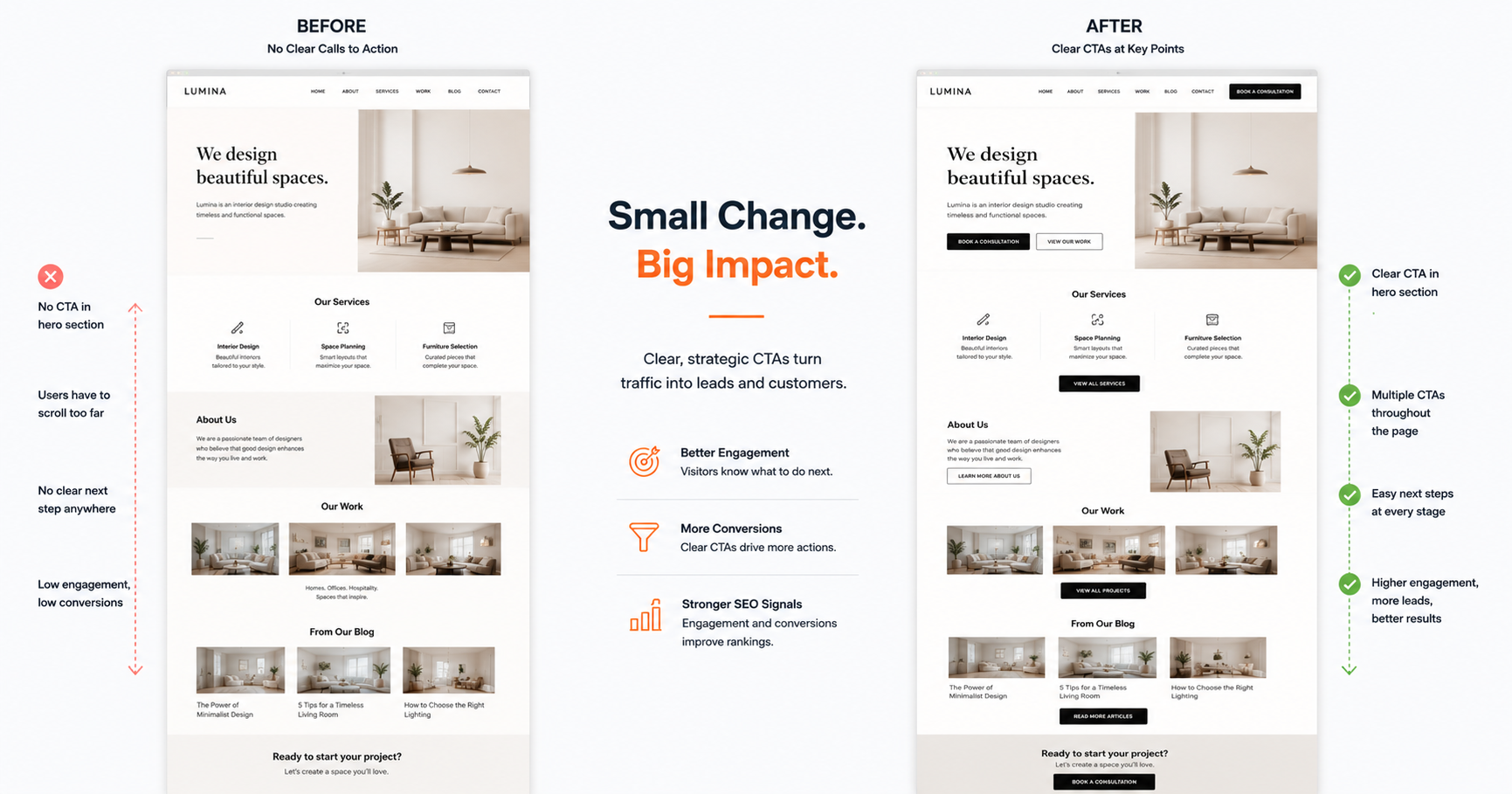
A website can rank well, load quickly, and present its content clearly, and still fail commercially if the user has no clear direction for what to do next. Missing or poorly positioned calls to action are one of the most consistent conversion failures we see in websites that are otherwise performing reasonably well from a traffic perspective.
The most common version of this problem is a CTA that appears only at the bottom of a long page. By the time a user reaches it, the majority have already left. The second most common version is a hero section with no action at all, which leaves the user oriented but directionless at precisely the moment their intent is highest.
From an SEO perspective, this matters because conversion signals feed back into how Google evaluates your page quality. A page that receives consistent traffic but generates no engagement, no form submissions, no click-throughs to service pages, is a page that Google interprets as failing to serve its visitors. Fixing CTA placement and copy is simultaneously a conversion fix and an SEO fix.
Three Strategic Steps Before Any SEO Work Begins
Even with a technically sound website, SEO fails reliably when the strategic layer beneath it is absent. These three foundations should be established before a keyword strategy or content plan is developed.
Define who you are actually trying to reach. Not in demographic terms but in behavioural ones. What problem is your ideal client actively searching for a solution to? What language do they use when they search? What does a purchase-ready prospect look like at the moment they are most likely to convert? The answers to these questions determine which keywords are worth targeting and which content will resonate once a visitor arrives.
Define what success looks like in commercial terms. Rankings and traffic are not business outcomes. Enquiries, conversions, and qualified leads are. An SEO strategy built around vanity metrics will optimise for the wrong things. One built around commercial outcomes will make different and better decisions about which pages to prioritise, which terms to target, and how to measure progress.
Audit what currently exists before building anything new. Identify which pages are already generating impressions or clicks, where drop-off is occurring, and which technical issues are suppressing performance. This baseline makes the entire strategy more efficient and prevents the common mistake of building new content on top of a foundation that is actively undermining it.
Fix the Foundation First
The question of why SEO fails almost always leads back to the same place: the website was not ready for the strategy sitting on top of it. Speed issues, poor mobile performance, weak architecture, absent trust signals, and missing CTAs do not just limit conversion. They actively suppress rankings by generating the behavioural signals Google uses to determine that a site is not worth surfacing.
The path forward is not more content or more backlinks. It is an honest assessment of the foundation. A website that is fast, clear, credible, and structured to guide visitors toward a decision is one that SEO can actually build on. Without that foundation, the work compounds nothing.
At Bixel Design, we audit websites against both technical SEO standards and Neuro Design principles, because a site that ranks but does not convert has solved the wrong problem. If you want to understand exactly what is holding your site back, we would be glad to consult with our team today.
Read more: Why Your Website Needs to Be User Friendly
Website: https://bixeldesign.com.au/contact/
Email: divya@bixeldesign.com.au