
Ask most business owners what their brand is and they will point to their logo. It makes sense. The logo is the most visible, most portable, and most immediately recognisable element of any brand. It is what appears on business cards, websites, social profiles, and signage. But it is also the most commonly mistaken proxy for something much larger, and that mistake has a measurable commercial cost.
A logo is a single mark. A brand identity is the complete system of visual, verbal, and experiential elements that communicates who a business is, what it stands for, and why it deserves to be chosen over every available alternative. According to 2026 branding research from Marketing LTB, consistent brand identity across platforms generates 33 percent higher brand recall. Companies that maintain it report up to 23 percent revenue increases. And yet only 30 percent of brands have guidelines that are widely used or accessible across their own organisation. The gap between knowing that brand identity matters and building one that actually functions is where most Australian businesses leave significant money on the table.
What Brand Identity Actually Includes
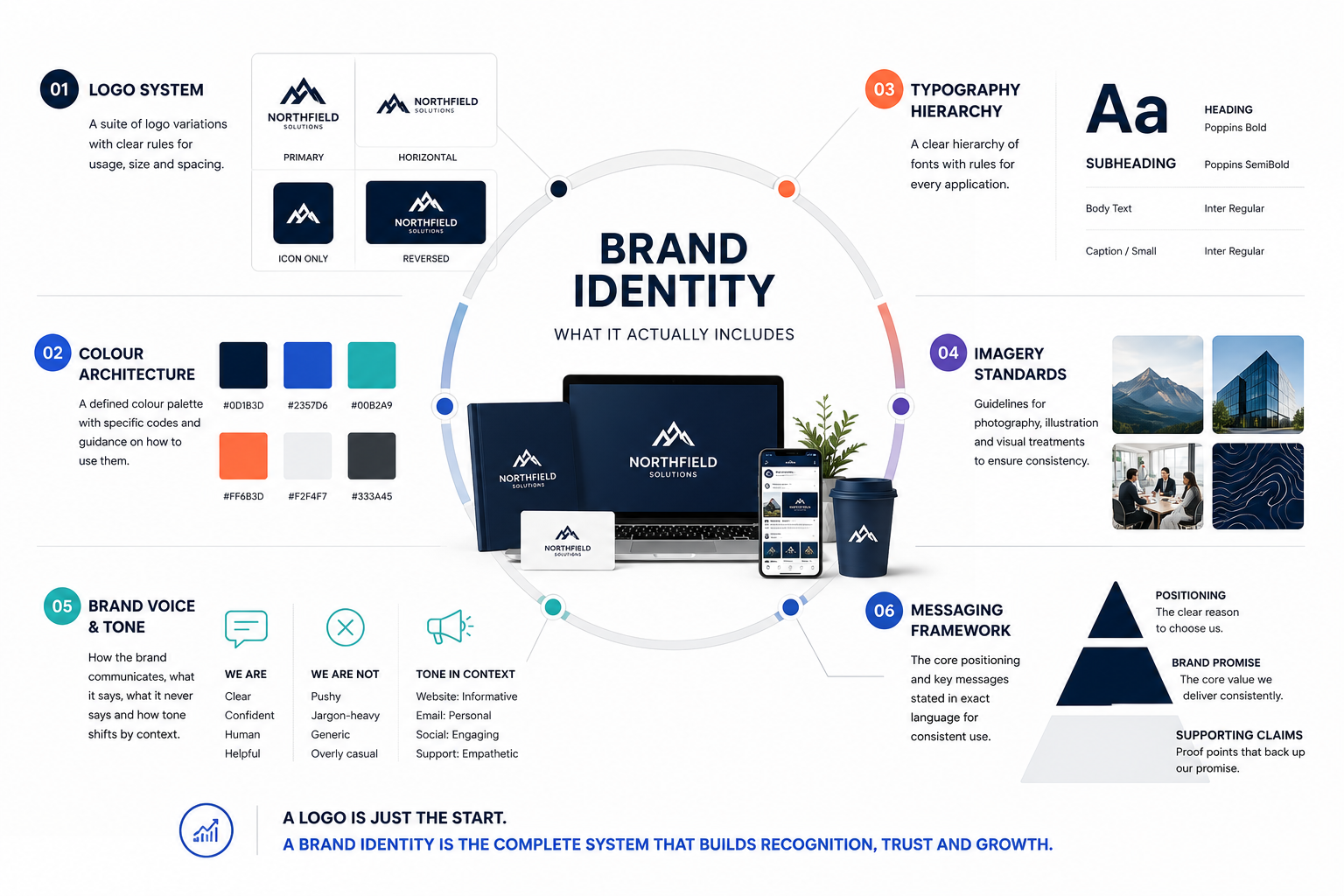
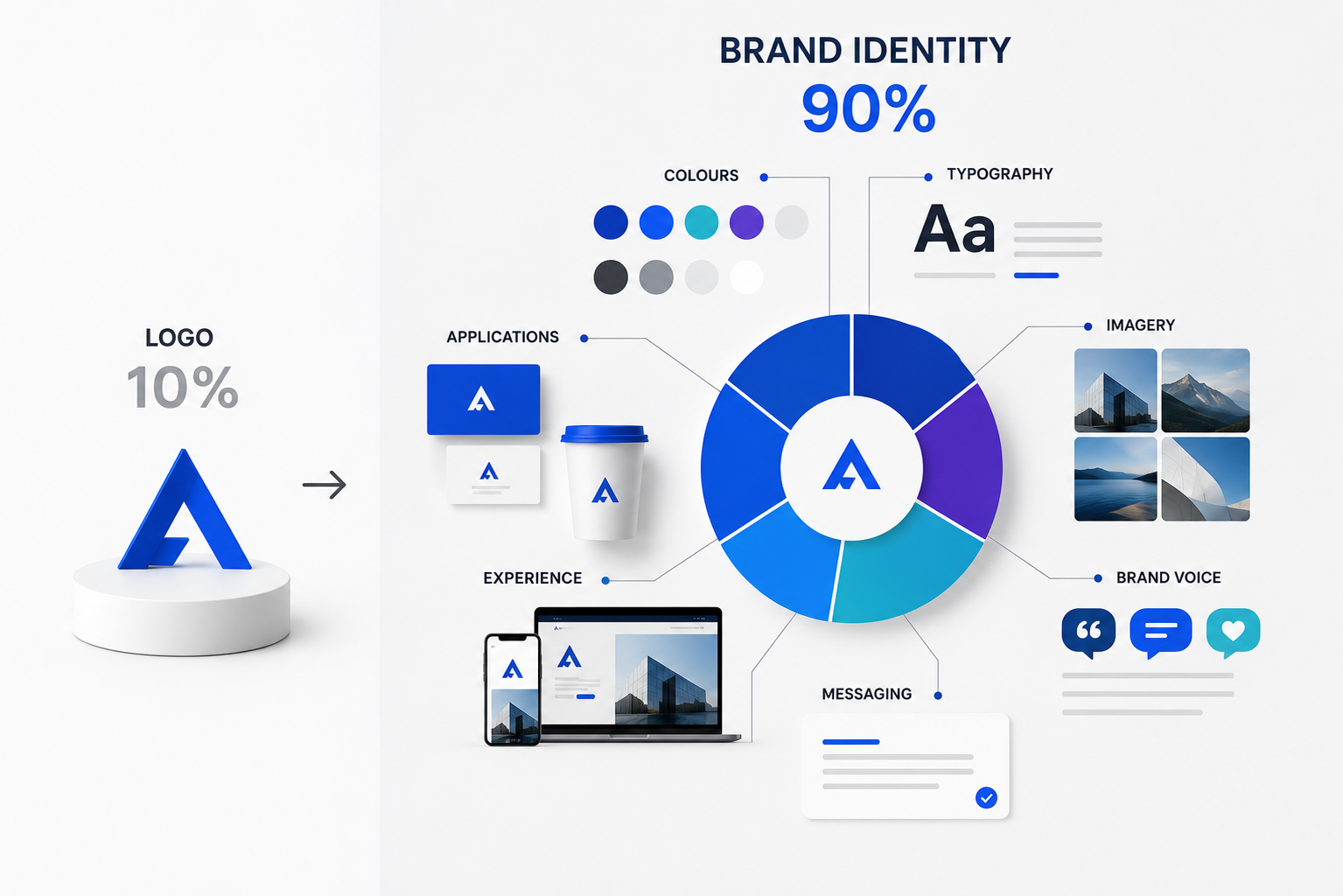
A complete brand identity is made up of three interconnected layers. Each layer communicates something about the business, and each one either reinforces or undermines the others.
The first is visual identity. This covers the logo, yes, but also the full colour system (including how colours are used proportionally across different formats), the typography hierarchy (which fonts carry which types of messages and why), the imagery style (what kinds of photographs, illustrations, or graphics the brand uses and how they are treated), and any supporting graphic elements that give the brand its distinctive visual texture. These elements combined are what make a brand recognisable before a word is read.
The second is verbal identity. This is the brand’s voice and messaging architecture. It determines what the business says about itself and how it says it. A brand’s verbal identity includes its positioning statement (the single clearest articulation of what the business is and who it serves), its core messaging pillars, the tone it uses across different contexts, and the specific language it employs to describe its work. Two businesses offering identical services at identical prices can produce entirely different conversion outcomes based on verbal identity alone.
The third is experiential identity. This is how the brand feels at every point of contact, from the first website visit to the way a proposal is formatted to the quality of the onboarding experience. Experiential identity is the layer most businesses do not plan deliberately, which is precisely why it is the most inconsistent and the most damaging when it fails. According to SeoProfy’s 2026 branding analysis, 88 percent of consumers say most brand messages do not reflect their needs or values. Experiential identity is where that gap is felt most acutely.
Most businesses invest in the logo and assume the brand will follow. A logo without the supporting identity system is like a shopfront without a shop behind it.
The Psychology Behind Why Brand Identity Converts
Understanding why brand identity design has such a measurable commercial impact requires looking at how the brain processes brands rather than how businesses typically think about them. The human brain encounters thousands of brand signals every day. To manage this volume, it relies on pattern recognition and cognitive shortcuts. Consistent brands are processed more quickly, remembered more reliably, and trusted more readily, because familiarity reduces the cognitive effort required to evaluate them.
Research published by DesignRush in 2026 found that it takes five to seven brand impressions before a logo becomes familiar to a consumer. But familiarity with a logo is only the beginning. Sustained brand recognition, the kind that influences purchase decisions, requires consistency across every other layer of the identity simultaneously. A logo that appears consistently but is surrounded by inconsistent typography, varying tonal registers, and different positioning statements across different platforms is not a consistent brand. It is a consistent logo with an inconsistent brand, which is a fundamentally different and considerably less valuable thing.
The commercial implication is straightforward. A business with a coherent, complete brand identity is building cumulative preference with every touchpoint. A business with a logo but no surrounding identity system is starting the trust-building process from near zero with each new encounter. In a competitive market, that difference compounds over time in one direction: against the business with the incomplete identity.
Why Most Australian Businesses Stop Too Early
The pattern we see most consistently when auditing brand foundations for Australian businesses is a well-considered logo sitting on top of an undefined identity. The logo was carefully developed, perhaps through a professional design process. But the colour system was never fully specified. The typography guidelines were never documented. The brand voice was never articulated. The imagery standards were never set. The result is a brand that presents differently every time it appears, depending on who created the asset and what tool they used to create it.
According to Demand Sage’s 2026 branding statistics, 77 percent of brands admit to publishing off-brand content at least occasionally. And 95 percent of companies have brand guidelines, but only 25 percent enforce them consistently. These numbers suggest that most businesses understand they need a brand identity but have not invested in making that identity functional and accessible across the organisation.
The consequences are practical. Marketing materials look different from the website. Social posts carry a different tone from the sales deck. The email signature uses a font that appears nowhere else in the brand. Each inconsistency is minor in isolation. Collectively, they communicate to the audience that the business is not sure what it is, which creates exactly the uncertainty that prevents conversion.
The Components of a Brand Identity That Actually Functions
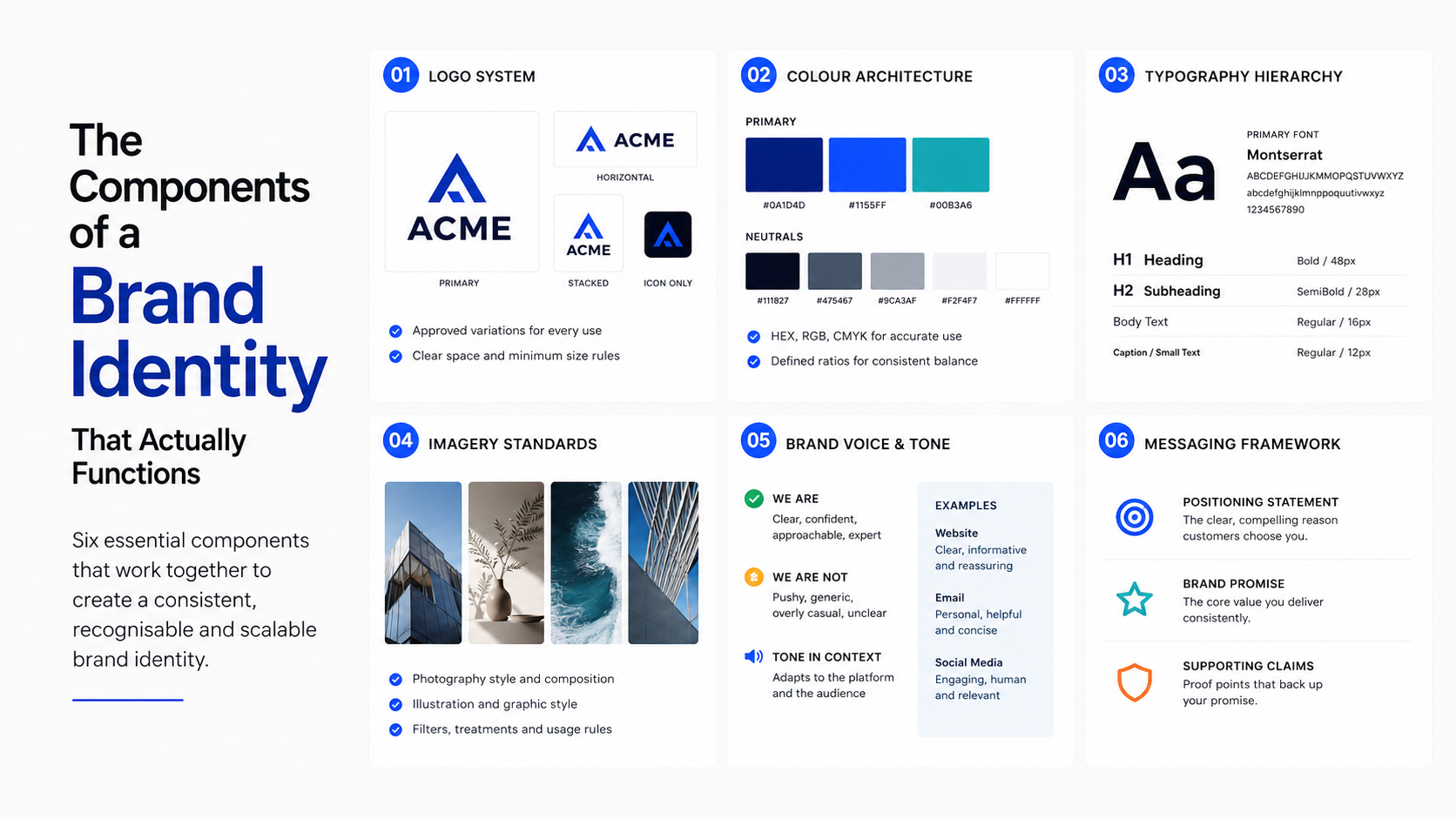
A functional brand identity is one that can be applied correctly by anyone in the organisation, at any time, on any platform, without the original designer present. For that to be possible, it needs to include the following:
- Logo system: not just the primary logo but the suite of approved variations (horizontal, stacked, icon-only, reversed) with clear guidance on when each version is appropriate and what minimum sizes and clearances apply
- Colour architecture: primary, secondary, and neutral palettes with specific HEX, RGB, and CMYK values, plus guidance on proportional use so the brand does not become a random mix of approved colours
- Typography hierarchy: primary and secondary typefaces with clear rules governing which font carries which function, including heading, subheading, body, caption, and any accent type applications
- Imagery standards: defined guidelines for photography style, illustration approach, and any graphic treatments applied to imagery, so visual assets feel cohesive regardless of who sources them
- Brand voice and tone guide: a clear articulation of how the brand communicates, what language it uses, what it never says, and how tone shifts appropriately between contexts such as a website landing page versus an email versus a social post
- Messaging framework: the core positioning statement and the supporting claims the brand makes about itself, stated in exact language so they can be used consistently across all marketing and sales materials
Without all six of these components documented and accessible, a brand identity exists in principle but not in practice. And a brand identity that exists only in principle produces the same commercial outcome as no identity at all.
What Poor Brand Identity Costs in Real Terms
The commercial cost of an underdeveloped brand identity is rarely visible in a single transaction. It is structural, operating at the level of how quickly trust is built, how much awareness is required before a purchase decision is made, and how much is spent on marketing to achieve results that a strong brand would produce with considerably less effort.
The data makes this concrete. According to Shapo’s 2026 branding research, businesses with inconsistent brands spend up to 1.75 times more on advertising and media to achieve the same growth as a consistently branded competitor. Across a twelve-month marketing budget, that multiplier is a substantial hidden cost. It also helps explain why some businesses feel like they are spending more on marketing than their competitors without generating proportional results. The spend is real. The brand foundation making it efficient is missing.
The positive case is equally clear. Consistent professional branding contributes to a 10 to 20 percent revenue increase for most businesses that implement it properly. Among businesses that invest in brand identity as a strategic priority rather than a visual project, 60 percent report adding 10 to 20 percent to revenue growth as a direct result. These are not outcomes attributable to advertising spend. They are the compounding effect of a brand that builds trust efficiently across every touchpoint it occupies.
Inconsistent brands spend up to 1.75 times more on advertising to achieve the same growth as consistently branded competitors. The brand is not a cost centre. It is the efficiency layer that makes every other marketing investment work harder.
Brand Identity and Its Relationship With Your Website
For most Australian businesses, the website is the primary commercial surface of their brand identity. It is where the visual system, the verbal identity, and the experiential layer all have to function simultaneously and coherently. A website built before a brand identity was fully defined will almost always carry the evidence of that gap: inconsistent typography, undefined imagery style, a tone that shifts between sections written by different people at different times.
This is why brand identity work and website design are most effective when treated as a single integrated project rather than sequential ones. A website designed to express a fully defined brand identity will outperform a website designed in the absence of one, because every design decision, from the layout to the content structure to the calls to action, can be made in service of a clear and consistent message rather than as a series of independent aesthetic judgements.
You can read more on how this consistency translates into commercial outcomes in our piece on how branding consistency across every touchpoint increases conversion rates. The relationship between brand identity and website performance is direct, and understanding it changes how both investments are made.
When to Invest in Brand Identity Work
For Australian businesses wondering whether now is the right time to invest in brand identity, the triggers are usually clearer in hindsight than in the moment. The most common indicators that a brand identity needs development or redevelopment are: inconsistent responses from the market that suggest confusion about what the business actually offers, difficulty articulating a clear differentiator from competitors, marketing spend that generates traffic without generating conversion, and a visual presence that no longer reflects the actual quality or positioning of the business.
The businesses that invest in brand identity design at the right moment are those that treat it as a foundation rather than a finish. The logo is where the brand begins. The identity system is what makes the brand functional. And a functional brand, applied consistently across every touchpoint, is what makes every other investment in marketing, sales, and operations work harder than it would in its absence.
For Sydney and Australian businesses specifically, a market where competition for attention and trust is intense, the investment is not a creative expense. It is a commercial one. According to 2026 data from SeoProfy, brand awareness now ranks as the single most important marketing metric for senior marketers globally, with 30 percent rating it extremely important and a further 36 percent rating it very important. In that environment, a business operating without a coherent brand identity is not just leaving first impressions to chance. It is leaving the most important metric in its category to chance.
The 10 Percent Problem
A logo is not a brand identity. It is the most visible element of one, which is different from being representative of the whole. The businesses that grow most efficiently, convert most reliably, and spend least on acquiring each new client are those that understand this distinction and have built the remaining 90 percent with as much care as they gave the mark itself.
At Bixel Design, we approach brand identity through Neuro Design principles: understanding how the brain processes each element of the system and building the identity to work with those processes rather than against them. The result is a brand that does not just look right. It builds trust efficiently, communicates clearly, and converts consistently across every surface it occupies.
If you are ready to build a brand identity that functions as a commercial asset rather than a visual formality, we would be glad to consult with our team today.
Website: https://bixeldesign.com.au/contact/
Email: divya@bixeldesign.com.au